
I've cooked hundreds of meals over a campfire, and I've learned one thing the hard way: your pan matters more than your recipe.
A cheap nonstick skillet warps over open flame. A thin aluminum pan creates hot spots that burn your food. Cast iron handles all of it. Direct flame, uneven coals, a grill grate that sits crooked on river rocks. Cast iron doesn't care. It absorbs heat, holds it steady, and gives you the kind of sear you can't get any other way.
I've narrowed this list down to 7 cast iron options that actually work for campfire cooking. Not just "outdoor-compatible" skillets that live in someone's kitchen. These are the ones worth hauling to a campsite.
1. Lodge 10.25 Inch Cast Iron Skillet

If you only buy one cast iron skillet for camping, make it this one. The 10.25-inch Lodge is the workhorse that every other skillet gets measured against. It comes pre-seasoned from the factory, which means you can cook on it right out of the box without spending an hour building up layers of oil.
The teardrop handle gives you enough room to grip with a glove or bandana when it's hot. At just over 5 pounds, it's heavy enough to sit stable on a grill grate but not so heavy that you'll dread packing it.
Pros:
- Pre-seasoned and ready to cook immediately
- Made in the USA by a company that's been doing this since 1896
- 10.25-inch size fits two steaks or a full breakfast spread
- Works on any heat source: campfire, grill, stove, oven
- The seasoning gets better every time you cook with it
Cons:
- 5+ pounds adds up in a backpack (this is a car camping skillet, not a backpacking one)
- Needs hand washing and a quick dry to prevent rust
- Handle gets dangerously hot over a fire, so bring a glove
The Lodge 10.25 is the cast iron skillet I recommend to people who have never owned one. The pre-seasoned surface performs well from the start, and after a few uses it develops that slick, dark patina that makes eggs slide right off. Over a campfire, it heats evenly and holds temperature even when you throw cold food on it. The one thing to watch: never plunge it in cold water while it's hot, or it can crack. Let it cool down naturally. Other than that, this thing is close to indestructible.
2. Lodge 12 Inch Cast Iron Skillet with Silicone Handle

Same Lodge quality as the 10.25 but with two extra inches of cooking surface and a red silicone handle cover included. If you're cooking for more than two people, the 12-inch gives you the room to actually sear food instead of steaming it in its own moisture because you overcrowded the pan.
The silicone handle holder is a nice touch. It slips on and off easily and saves you from the "grab the hot handle and regret it" moment that every campfire cook has experienced at least once.
Pros:
- 12-inch surface fits enough food for 3-4 people
- Silicone handle cover included (actually useful, not a gimmick)
- Same pre-seasoned surface as the smaller Lodge
- Made in the USA
Cons:
- Heavier than the 10.25 model, so plan your packing accordingly
- The silicone handle will melt if it falls into the fire (don't ask how I know)
- Takes up more space in your camp kitchen setup
The 12-inch Lodge is what I bring when I'm cooking for a group at a car camping site. It handles big batches of bacon, can sear four burgers at once, and makes a mean campfire cornbread if you have a lid or some foil. The extra size means extra weight, though. For solo trips or anything where you're carrying your gear more than 100 yards, the 10.25 makes more sense.
3. Utopia Kitchen Cast Iron Skillets 3-Piece Set
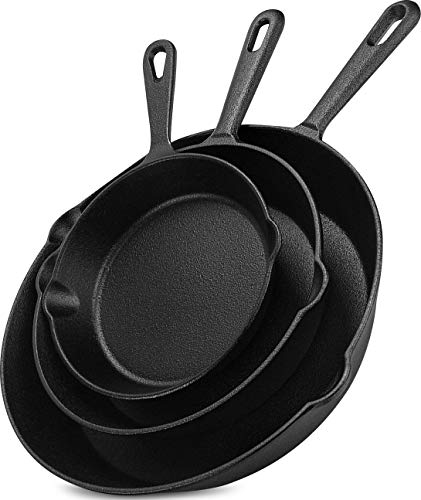
Three skillets (6, 8, and 10 inches) for roughly the price of one Lodge. If you're building out a camp kitchen from scratch and don't want to spend Lodge prices on every piece, this set gets you started. The pre-seasoning isn't as good as Lodge's right out of the box, but after a few rounds of cooking it catches up.
The 6-inch is surprisingly useful. I use the small one for melting butter, toasting spices, or warming a side while the main pan handles the protein.
Pros:
- Three sizes for the price of one premium skillet
- The 6-inch pan is handy for small tasks most people don't think about
- Pre-seasoned and ready to use
- Works on campfires, grills, stoves, and ovens
Cons:
- Factory seasoning is thinner than Lodge, so expect some sticking early on
- The handles are shorter, which means your knuckles are closer to the heat
- Five pounds for the whole set, so weight stacks up fast if you bring all three
Solid budget option. The Utopia set won't blow you away on the first cook, but cast iron is forgiving. Season these a few times (cook bacon, wipe with oil, repeat) and they'll perform well for years. I'd recommend this set for someone who's just getting into campfire cooking and wants to try different sizes before committing to a single premium piece.
4. Lodge 10.5-Inch Cast Iron Round Griddle
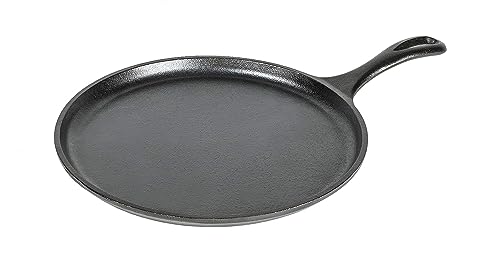
This isn't a skillet, it's a griddle. No sides, just a flat cooking surface with a handle. That distinction matters at a campsite.
A griddle is what you want for breakfast duty. Pancakes, eggs over easy, grilled cheese sandwiches. The flat surface means you can slide a spatula under anything without fighting against walls. At 4.5 pounds, it's lighter than a full skillet and sits flat on most grill grates.
Pros:
- Flat surface is perfect for pancakes, eggs, and sandwiches
- Lighter than a full skillet at 4.5 pounds
- Pre-seasoned Lodge quality
- Easy to clean because there are no corners where food gets trapped
Cons:
- No sides means no sauces, no liquid, no stir-frying
- Food can slide right off if your grate isn't level
- Only 10.5 inches, which limits how many pancakes you can fit at once
I bring the griddle when I know the menu is breakfast-heavy. It does one thing and does it well. If you try to sear a steak on it, the juices will run off the edges. But for anything flat, it's better than a skillet because you get full access to the cooking surface from every angle.
5. Lodge Reversible Grill/Griddle
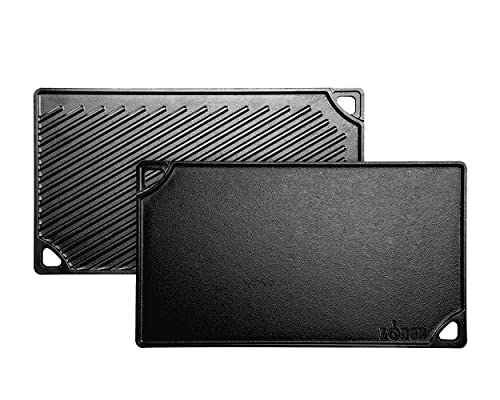
Flip it one way and you get a flat griddle. Flip it the other way and you get raised grill ridges for sear marks. Two cooking surfaces in one piece of cast iron. At 9.5 by 16.75 inches, it also gives you more total cooking area than a round skillet.
The catch? It weighs 8 pounds. This is not something you toss in a daypack. But for a base camp or a car camping setup, the versatility is worth the weight.
Pros:
- Two cooking surfaces in one piece (flat griddle + ridged grill)
- Large rectangular surface fits more food than a round pan
- Pre-seasoned Lodge quality
- Grill ridges give steaks and burgers proper sear marks
Cons:
- 8 pounds is heavy, full stop
- Rectangular shape is awkward to pack
- Needs a stable, flat surface or it'll rock on uneven coals
I use this one mostly at home and on car camping trips where weight doesn't matter. It spans two burners on a camp stove, which is handy for cooking a big batch of anything. The grill side produces those restaurant-quality ridges on chicken and steak. Just make sure your heat source is wide enough, because a single burner won't cover the whole surface evenly.
6. Lodge 12-Inch Skillet with Dual Assist Handles
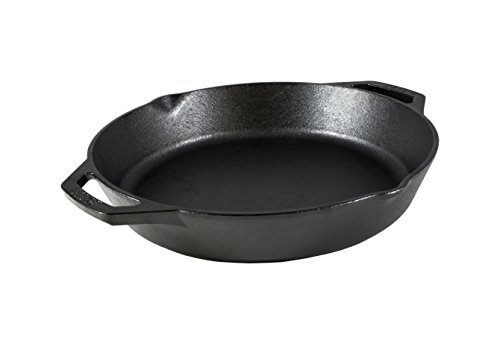
Same size as the #2 pick but with two assist handles instead of one long handle plus a helper. The dual-handle design makes a real difference when you're lifting a loaded skillet off a fire. You can grab both sides with two gloved hands and carry it level, which is harder to do with a single long handle and a tiny helper tab.
At 6.6 pounds empty, add food and this thing is a serious lift. The dual handles make that manageable.
Pros:
- Dual assist handles make lifting safer and more balanced
- 12-inch surface for group cooking
- Pre-seasoned and improves with use
- Lower profile than long-handled models, stores more compactly
Cons:
- No long handle, so you need gloves or pot holders for everything
- 6.6 pounds before you add food
- Harder to tilt and pour compared to a single-handle skillet
Pick this over the standard 12-inch Lodge if you do a lot of lifting on and off fire. The dual handles distribute the weight better and give you more control. I'd avoid it if you like to tilt the pan to baste with butter, though. For that technique, a long handle is better. Know your cooking style and pick accordingly.
7. Lodge 5-Quart Cast Iron Double Dutch Oven

This is the most versatile piece on the list. The lid flips over and becomes a 10.25-inch skillet, so you're actually getting two pieces of cookware in one. The 5-quart pot is big enough for stews, chilis, soups, and baking bread over a campfire. Stack some coals on the lid and you've got a camp oven.
At over 13 pounds, it's the heaviest option here by a wide margin. But if you only want to bring one piece of cast iron to camp, this is the one that does the most.
Pros:
- Lid converts to a 10.25-inch skillet (two pieces in one)
- 5-quart capacity handles stews, chili, and bread baking
- Pre-seasoned and PFAS-free
- Stack coals on the lid for oven-style cooking at a campsite
- Made in the USA
Cons:
- 13+ pounds is serious weight for any trip
- Bulky shape takes up a lot of space in a bin or pack
- Cast iron takes a while to heat up, so plan ahead
The Double Dutch Oven is what I bring on longer car camping trips where I want to cook real meals. A pot of chili on night one, flip the lid and fry eggs in the morning. It's slow to heat and heavy to carry, but the cooking it produces is worth the effort. If you've ever eaten fresh sourdough bread baked in a Dutch oven over campfire coals, you understand.
How to Pick the Right One
Choosing between these comes down to how you camp and what you cook:
- Solo or duo, car camping: Lodge 10.25-inch skillet (#1). Light enough to be practical, big enough for two.
- Group cooking: Lodge 12-inch with silicone handle (#2) or dual handles (#6).
- Budget build-out: Utopia 3-piece set (#3). Get three sizes for the price of one Lodge.
- Breakfast-heavy trips: Lodge griddle (#4). Pancakes and eggs without fighting skillet walls.
- Maximum versatility: Lodge Double Dutch Oven (#7). One piece that does everything, if you can handle the weight.
Cast Iron Care at Camp
A few rules that will keep your cast iron in good shape for decades: While you're at it, take a look at our grilling gloves. While you're at it, take a look at our fire starters. While you're at it, take a look at our compact spice kit.
- Never use soap (a little is fine if you rinse well, but water and a scraper does the job)
- Dry it immediately after washing. Moisture is rust's best friend.
- Rub a thin layer of oil on the cooking surface before you pack it away
- Never put a hot skillet in cold water. Let it cool on its own.
- If rust appears, scrub it with steel wool, re-season with oil in a hot oven, and it'll come back
Bottom Line
Cast iron is the one piece of camp cookware that gets better the more you use it. Every one of these options will outlast your tent, your sleeping bag, and probably your car. Pick the size and style that fits how you cook, take care of it, and you'll have it for life.


