
Cell service disappears fast once you leave the highway. I've camped in spots where the nearest tower is 40 miles away and weather can change from clear to dangerous in an hour. An emergency radio closes that information gap.
I look for three things: reliable NOAA weather alerts, multiple power sources, and enough features to justify the weight. A radio that only does one thing well isn't as useful as one that handles weather, charges your phone, and lights your way back to camp.
1. Fospower Emergency Weather Radio

This is the radio I actually use. The 7400mWh power bank has charged my phone from dead to 60% multiple times. Solar charging works in direct sunlight, but don't count on it as your primary power source. The hand crank is there when everything else fails.
NOAA alerts have warned me about incoming storms twice. Once, it gave me enough notice to pack up and move to lower ground before the wind made my tent stakes useless. The SOS alarm is loud enough to hear from a distance.
Pros:
- Power bank capacity handles multiple phone charges
- Three power sources mean you're never completely stuck
- NOAA alerts provide advance warning of weather changes
- Compact enough for a backpack side pocket
- Flashlight is brighter than expected
Cons:
- Solar charging is slow in anything less than full sun
- Speaker volume could be louder in windy conditions
2. Raynic Emergency Radio

The 5000mAh battery outlasts the FosPower by a noticeable margin. I've gotten three days of regular use without recharging. Shortwave reception adds international stations if you're camping near borders or just want more listening options.
The headphone jack is a small detail that matters. Late at night when everyone else is asleep, I can check weather forecasts without waking the camp. SOS siren has that piercing quality that carries over distance.
Pros:
- Larger battery provides more runtime per charge
- Shortwave adds listening variety
- Headphone jack enables private listening
- Multiple charging methods provide flexibility
- SOS mode is attention-getting
Cons:
- Slightly heavier than smaller models
- Hand crank feels stiff when cold
3. Emergency Weather Radio

The 37000mWh capacity is almost absurd for a camping radio, but it means you can charge multiple devices without draining it. Reading lamp mode is useful for camp tasks after dark without burning through headlamp batteries.
Built-in compass is basic but functional. I wouldn't navigate solely by it, but it's handy for quick reference. Three flashlight modes cover different brightness needs without cycling through options you don't want.
Pros:
- Massive battery handles extended trips
- Reading lamp provides area lighting
- Compass adds navigation backup
- Three flashlight modes prevent unnecessary cycling
- NOAA alerts are clear and loud
Cons:
- Large battery means more weight
- Solar panel needs frequent cleaning to work well
4. Emergency Hand Crank Radio
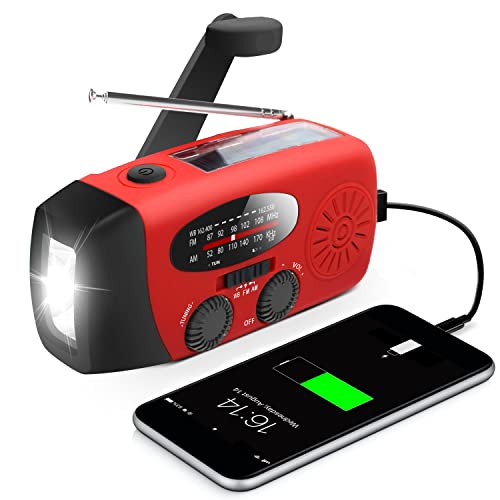
The 2000mAh capacity is modest compared to larger models, but it keeps the weight down. This radio fits in spaces where bulkier options won't, making it good for tight packs or as a backup unit.
Hand crank charges faster than expected. Five minutes of cranking provides 30-40 minutes of radio time or enough charge to make an emergency call. The LED flashlight serves as a basic beacon if you need to signal for help.
Pros:
- Compact size fits anywhere
- Hand crank is efficient
- Light weight won't slow you down
- NOAA reception is reliable
- Simple interface, easy to operate
Cons:
- Smaller battery limits phone charging capability
- Flashlight is dim compared to dedicated lights
5. Emergency Radio Hand Crank Solar

This kit bundles a solid radio with survival gear you should carry anyway. The headlamp is rechargeable from the radio, creating a connected power system. Thermal blanket and survival bracelet add value without adding much bulk.
10000mAh strikes a balance between capacity and weight. I've charged my phone twice and still had enough power for a full day of radio use. The headlamp provides hands-free lighting that beats holding a flashlight while setting up camp.
Pros:
- Complete survival kit in one package
- Rechargeable headlamp eliminates extra batteries
- Thermal blanket adds emergency warmth
- 10000mAh handles multiple devices
- NOAA alerts come through clearly
Cons:
- Bundled items increase overall kit weight
- Hand crank takes effort to generate power
6. Midland Er210 Noaa Emergency Weather Radio

Midland makes actual emergency communication gear, not just camping accessories. This radio reflects that focus. Weather alerts are precise and timely. Reception pulls in signals where cheaper radios give you static.
The compact design disappears in a pack but still feels solid. SOS flashlight flashes at a rate that's recognizable as a distress signal. Multiple power sources include options most radios skip, like standard batteries.
Pros:
- Professional-grade reception quality
- Compact without feeling cheap
- SOS flashlight uses proper signaling pattern
- Multiple power sources include standard batteries
- Weather alerts are accurate and detailed
Cons:
- Small screen can be hard to read in bright sun
- Hand crank requires sustained effort
7. Solar Radio Emergency Hand Crank 12000mah

The dual USB outputs let you charge two devices simultaneously, which matters when you're sharing camp space. Clear signal reception works in valleys where other radios struggle. 12000mAh provides enough capacity for extended trips without rationing power.
Two-mode flashlight keeps it simple. Bright when you need it, dim when you don't want to kill your night vision. SOS function is easy to activate even in stress situations. While you're at it, take a look at our solar charger. While you're at it, take a look at our GPS watch for navigation. While you're at it, take a look at our survival tent.
Pros:
- Dual USB ports charge multiple devices
- Signal clarity beats most budget radios
- 12000mAh handles power-hungry phones
- Simple two-mode flashlight reduces confusion
- Hand crank generates power efficiently
Cons:
- Solar charging is slow in overcast conditions
- Large battery adds weight
How to Pick the Right One
- For solo backpacking: Choose compact models with hand crank as primary backup power.
- For base camp: Larger battery capacity supports multiple devices and extended use.
- For group trips: Dual USB outputs let you charge multiple phones without waiting.
- For serious weather monitoring: Pick radios with clear NOAA reception and headphone jacks for private listening.
- For emergency kits: Bundle kits with thermal blankets and headlamps add value for similar weight.
Bottom Line
A radio isn't exciting gear, but it's the piece that can change a bad situation into a manageable one. I've avoided dangerous storms because NOAA alerts gave me advance warning. The phone charging capability has saved trips when dead batteries would have ended them early. Pick based on your battery needs and how remote you typically camp.


