
When the power goes out or you're days into the backcountry, your phone becomes critical. GPS, emergency calls, weather updates. A dead phone is a safety risk. Solar chargers convert sunlight into power, keeping devices charged when outlets don't exist.
Look for capacity measured in mAh (higher numbers charge more devices), charging speed, and durability that handles weather. Built-in features like flashlights or compasses add value. Foldable solar panels work well for stationary camps. Power banks with solar panels work for on-the-go charging.
1. Power-bank-solar-charger

42,800mAh capacity charges a phone 10+ times. I've used this on multi-day trips where solar is the only option. QC 3.0 fast charging works well when you have wall power. Solar charging is slow but functional in full sun.
The built-in flashlight is bright enough for camp tasks. Orange color makes it easy to find in a pack. At 1.1 pounds, it adds weight but the capacity justifies it.
Pros:
- Massive 42,800mAh charges multiple devices
- QC 3.0 fast charging when plugged in
- Super bright flashlight useful at camp
- Orange color easy to locate
Cons:
- Solar charging slow in weak light
- Larger than pocket-sized options
- Orange not everyone's preference
2. Errbbic Solar Charger Power Bank

49,800mAh is the highest capacity on this list. Four built-in cables mean you don't need to carry extras. 15W wireless charging works for compatible phones. 22.5W wired charging is fast when you have power.
Solar panel charges slowly but provides a backup option. Dual flashlight is practical for nighttime camp needs. Bulkier than smaller power banks but the features compensate.
Pros:
- 49,800mAh charges devices multiple times
- Built-in cables eliminate need for extras
- 15W wireless charging is convenient
- Dual flashlight enhances utility
Cons:
- Solar charging depends on sunlight intensity
- Bulky compared to smaller models
- Wireless charging slower than wired
3. Solar Charger Power Bank
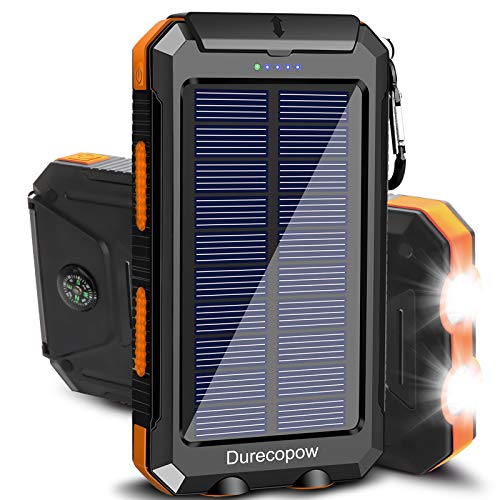
Waterproof construction handles rain and splashes. 20,000mAh capacity is enough for most weekend trips. Two LED flashlights provide light for tasks. Built-in compass is a nice touch for navigation.
At 0.55 pounds, this is one of the lighter solar power banks. USB-C input and output work with modern devices. Orange color is highly visible.
Pros:
- Waterproof for outdoor conditions
- 20,000mAh handles weekend trips
- Two LED flashlights included
- Compass aids navigation
Cons:
- Solar charging slower than wall charging
- Orange only color option
- Thin design may affect durability
4. Goodaaa Power Bank Wireless Charger

The hand crank feature sets this apart. When solar fails and battery is low, you can manually generate power. It's slow but works in emergencies. 45,800mAh capacity is substantial. Seven outputs charge multiple devices simultaneously.
SOS and strobe flashlights are useful for emergency signaling. Compass adds navigation backup. This is the most feature-rich option but also the most complex.
Pros:
- Hand crank provides emergency power
- 45,800mAh capacity is very high
- Seven outputs charge multiple devices
- SOS and strobe for emergencies
Cons:
- Bulkier than simpler models
- Solar charging slow in low light
- Hand crank requires physical effort
5. Eoxsmile Emergency Radio
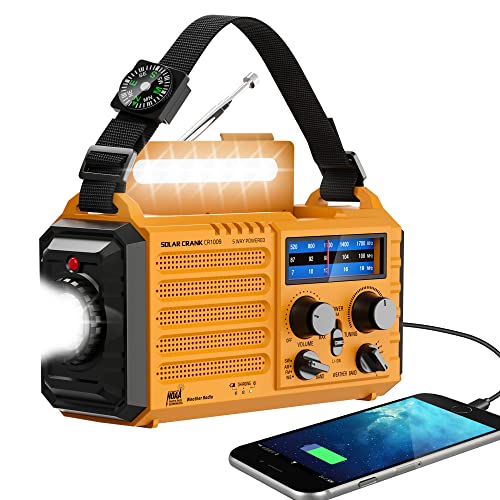
This combines radio with charging capability. NOAA weather alerts matter in emergency situations. 5,000mAh battery charges phones via USB. Solar and hand crank provide charging options.
AM/FM and shortwave radio keep you informed when cell service fails. Flashlight and SOS alarm add safety features. At 0.93 pounds, it's portable for emergency kits.
Pros:
- NOAA weather alerts for emergencies
- Multiple charging options including solar
- AM/FM/shortwave radio reception
- Flashlight and SOS alarm included
Cons:
- Shortwave reception varies by location
- Hand crank charging is slow
- Flashlight not very bright
6. Bigblue 3 Usb Ports 28w Solar Charger
![[Upgraded] BigBlue 3 USB Ports 28W Solar Charger(5V/4.8A Max), Portable Foldable Solar Panel for Camping, IP44 Waterproof, Compatible with iPhone 11/XS/XS Max/XR/X/8/7, iPad, Samsung Galaxy LG etc.](https://m.media-amazon.com/images/I/41jiYtfANJL._SL500_.jpg)
Foldable solar panels work better than power bank solar panels. More surface area captures more light. 28W output charges devices reasonably fast in full sun. Three USB ports handle multiple devices.
IP44 waterproof rating protects from light rain. At 1.48 pounds, it's portable but requires setup. This is for base camps, not hiking with.
Pros:
- 28W output charges faster than small panels
- Three USB ports charge multiple devices
- Foldable design packs reasonably small
- IP44 waterproof for light rain
Cons:
- Charging speed depends on sunlight
- Requires additional power bank for storage
7. Blavor Solar Charger Power Bank
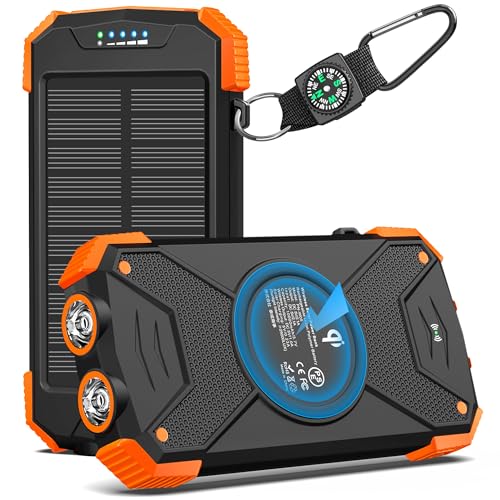
10,000mAh is enough for a few phone charges. 20W fast charging delivers power quickly. Wireless charging eliminates cable tangles. Dual flashlight is useful at camp.
At 0.58 pounds, this is one of the lightest options. Compact size fits in jacket pockets. Solar panel works in emergencies but wall charging is faster. While you're at it, take a look at our portable battery charger. While you're at it, take a look at our emergency radio. While you're at it, take a look at our solar lantern.
Pros:
- Compact and lightweight
- 20W fast charging is quick
- Wireless charging convenient
- Dual flashlight for camp
Cons:
- Solar charging slow in low light
- 20W output limited for high-power devices
How to Pick the Right One
- For extended trips: ERRBBIC 49,800mAh or GOODaaa 45,800mAh provide maximum capacity.
- For lightweight hiking: Blavor 10,000mAh or Solar Charger 20,000mAh minimize weight.
- For emergency preparedness: GOODaaa with hand crank or Eoxsmile radio provide backup options.
- For base camp use: BigBlue foldable panels charge fastest in full sun.
- For weather resistance: Solar Charger 20,000mAh waterproof handles rain.
- For multiple devices: GOODaaa with seven outputs or BigBlue with three USB ports.
Bottom Line
Solar chargers keep devices powered when outlets don't exist. For most outdoor users, the 42,800mAh power bank or ERRBBIC 49,800mAh provide enough capacity for multi-day trips. If weight matters, the Blavor 10,000mAh works for weekend trips. Remember that solar charging is slow, so charge via wall power before leaving home.


